Soothing Tooth (2023)
An interactive public installation to help children alleviate their fear while waiting to see the dentist.
Project Overview
Project Summary
This project addresses the critical issue of dental anxiety in children (ages 3-6) by designing and building an interactive installation for pediatric dental waiting rooms. The system transforms the frustrating waiting experience into a soothing educational game through real-time physical interaction.
From an engineering perspective, the system functions as a closed-loop IoT network. Pressure sensors and tilt sensors collect analog data, which is processed by an Arduino microcontroller and transmitted via serial/Bluetooth communication to a host software. Consequently, immediate visual feedback (LEDs and Unity-based animations) are displayed when data is received.
To optimized the performance of the system, standard pressure sensors were replaced with self-developed velostat-based sensors after empirical verification.
My Contributions
As the technical lead for a team of 4, I was responsible for the technical implementation of the installation prototype, including:
Physical Prototyping & Manufacturing
Embedded System & Circuit Design
IoT Communication & Software Integration
Custom Sensor R&D & Experiment Verification
Project Pitching & Presentation (During Competition Pitch)
Tech Stack
Modeling & Physical Prototyping: Shapr3D, 3D Printing
Embedding System Programming: Arduino
Software Development: Unity Engine
IoT Communication: Bluetooth, Socket/Serial Protocol
Experiment & Data Processing: MatLab
Acknowledgements
Thanks to Prof. Zhao Liu for guidance, and to Shanghai Jiaotong University Student Innovation Center for technical support.
Problem Framing
Design Necessity
The oral healthcare market in China is growing rapidly. Despite high disease rates of dental health issues among children, the treatment rates are alarmingly low. Therefore, it is essential to bridge the gap between disease prevalence and treatment.
Market Growth
Oral Health Issues
Identifying Problem: Children’s Dental Fear
Based on our desktop research, there is a significant age-based distribution of dental fear in China. Therefore, we propose the hypothesis that children’s fear of dentists is a significant cause of this gap.
Dental Fear Prevalence
User Research
To validate our hypothesis, we surveyed 127 parents whose children have oral health issues using a questionnaire on their experiences with dental hospital visits. Key results are as follows:
Evidence-Based Problem Definition
Based on our research, we defined the problem to be addressed: to help children alleviate their fear while waiting to see the dentist.
Solution & System Architecture
Solution Overview
Soothing Tooth is an interactive installation combining physical installation design and interactive gameplay, placed in pediatric dental clinic waiting areas. It draws inspiration from children’s play spaces, interactive toys, and educational games, and incorporates human-computer interaction elements, allowing for software updates and customizable branding.
Our design aims to draw the attention of children so that their fear and anxiety are relieved. Additionally, it offers guidance of daily tooth-brushing routine through gamified hands-on experience, which is an ideal by-product welcomed by parents and medical workers.

" height="174px" id="n1d1wE8r7" transform="translate(13 13)" width="174px"/></svg>)

" height="173.3573819462307px" id="zQrCVzEt_" transform="translate(13 13.5)" width="174px"/></svg>)

User Journey & Interaction
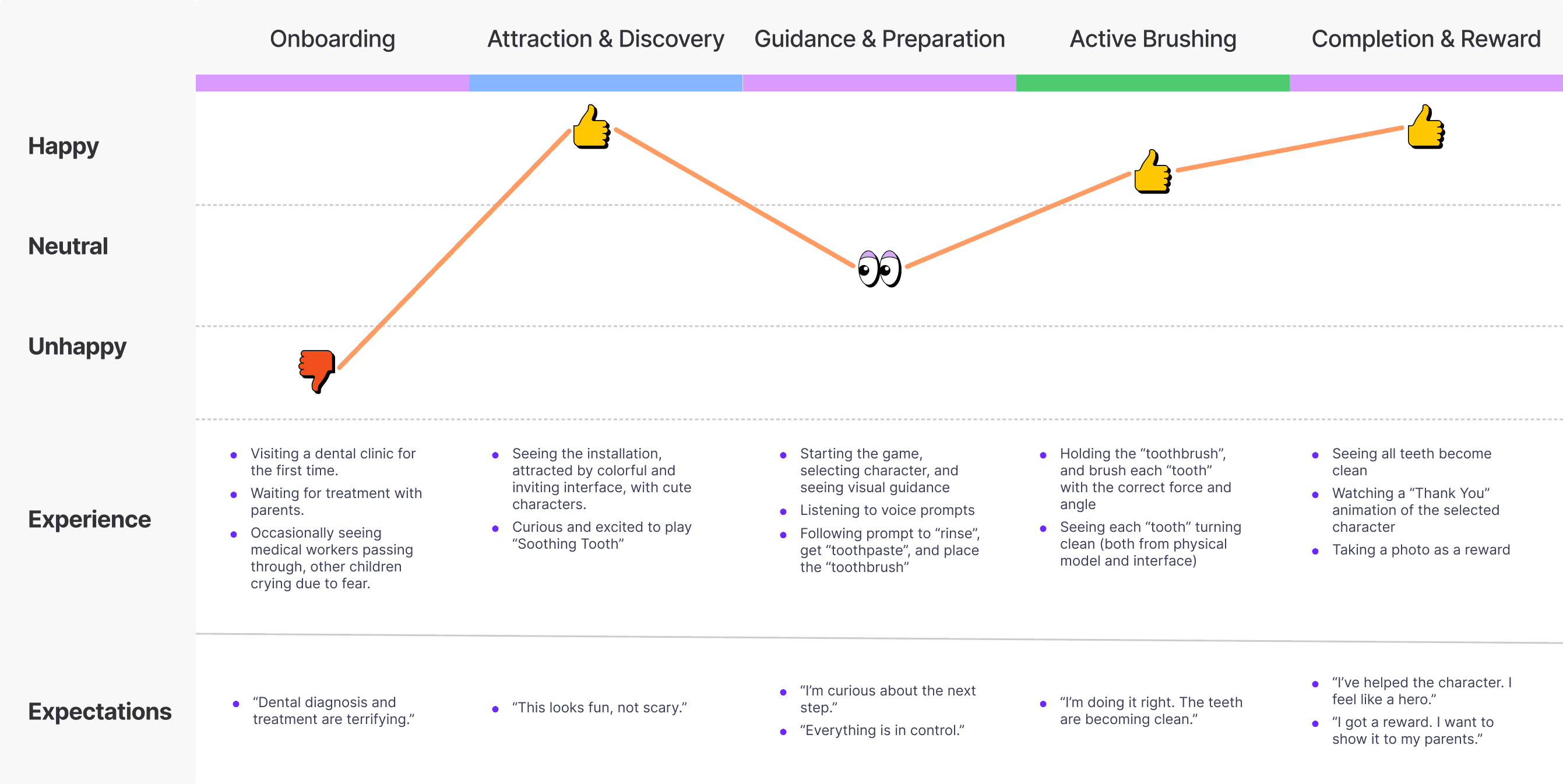
The game turns the standard brushing process into a game, distracts the child from the clinical environment, and addresses dental fear. The user journey starts with visual and voice prompts, simulates the “rinse-paste-brush” flow, and ends with a celebration, ensuring the child leaves with a positive memory associated with dental care.
Tech Roadmap
The technical challenge of simulating the tooth brushing process with an interactive installation is: how to accurately identify the position and angle of the toothbrush model and the pressure between the toothbrush model and the teeth model, and how to create feedback-loop through real-time visual hints.
We utilized pressure sensors and tilt sensors to capture posture and pressure data. The Arduino board served as the central processing unit, with a communicating bridge developed for real-time data stream transmission. Visual feedback were provided via physical light indicators and a screen interface.

Technical Implementation
Circuit Design
The tooth models integrate pressure sensors detecting the force of contact between the toothbrush model and the tooth model; yellow and white LEDs are used to indicate the states each tooth model (healthy vs. diseased). The toothbrush model has a 3-axis tilt sensor to detect its position, and a bluetooth module for data transfer.
With the pressure sensor built in the tooth models and the tilt sensor in the toothbrush, the system manages to determine if the child is “brushing” the “teeth” with a proper force and direction; and visual feedback is delivered via the color of LED lights through each tooth model.


Scaled Model Design
We built 3d models for all components (base, toothbrush model, tooth models) in Shapr3D. For the 3d-printed prototype, we scaled the models to a manageable size (10:1).


Physical Prototyping & Testing
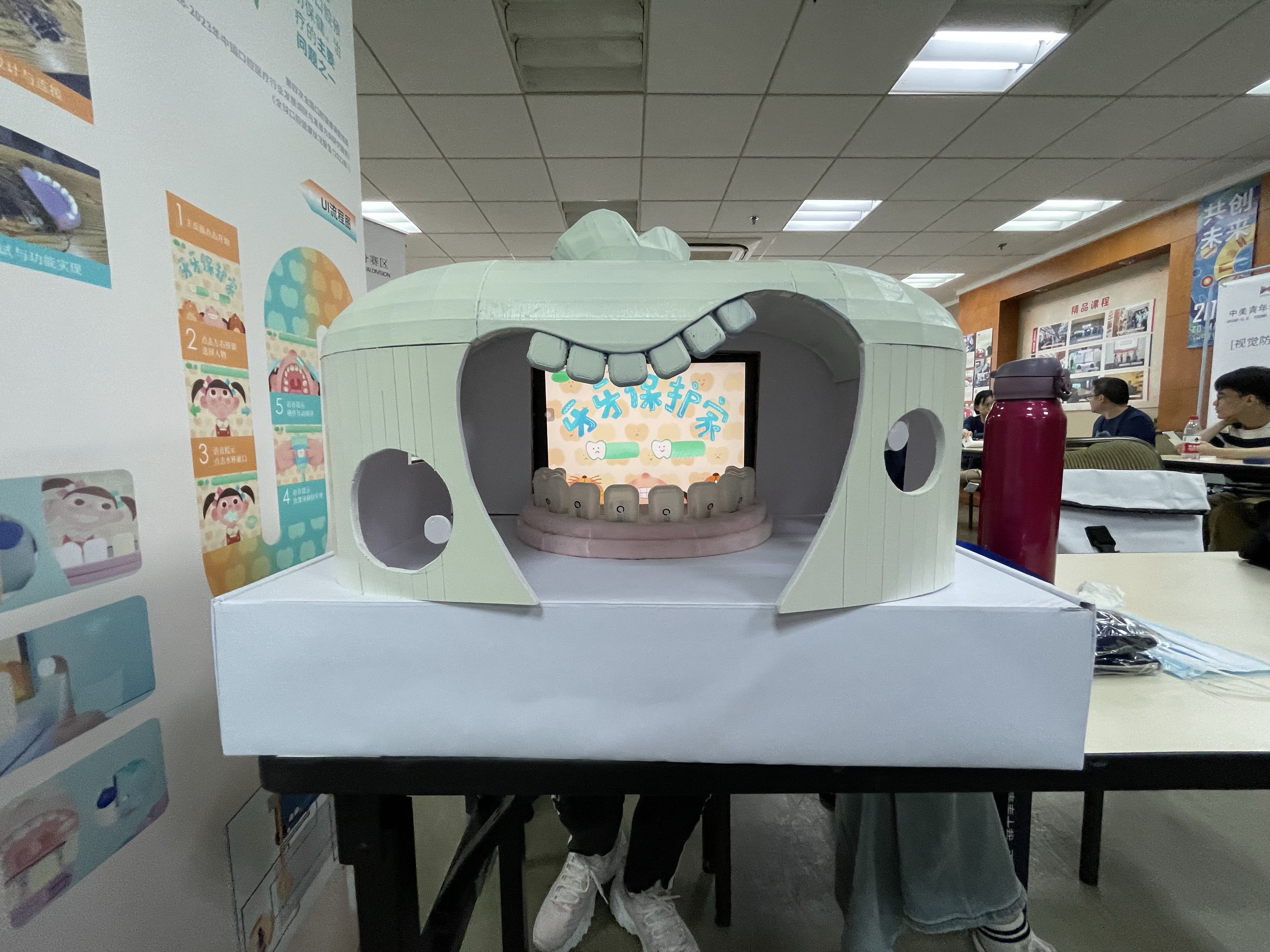
We made a 3D-printed base to house the microcontroller and the circuitry, which is covered with fabric on the surface. Meanwhile, we selected translucent 3D printing material to make the teeth, using different colors of LED lights to indicate the status of the teeth. A tablet computer was used to display the software interface, providing gamified interaction.


Software Development
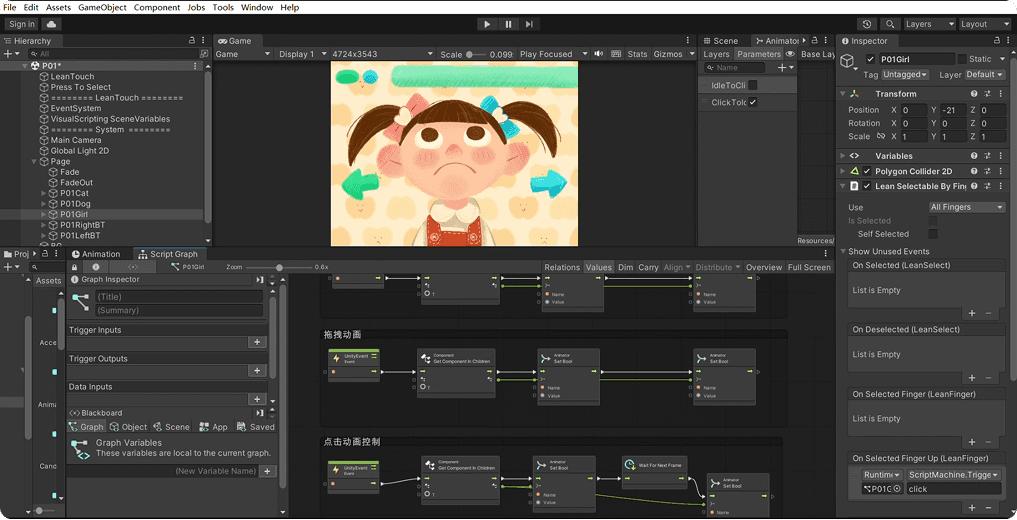
We used Unity Engine to develop the software, and used Ardity Unity Package for data communication between hardware and software prototypes via socket/serial protocol.

Project Outcome & Pitching
As the technical lead, I pitched Soothing Tooth to a panel of judges and industry mentors during CHINA-US. YOUNG MAKER COMPETITION, translating our engineering work into a clear, compelling story. I opened with the validated problem—children's dental anxiety, backed by our research and survey—then brought the solution to life with a live demo of the interactive installation, earning the project the Second Prize in the Shanghai Division.

Iterative Optimization
Reflection: Problem
For the prototype, we attached standard pressure sensors to the teeth model, which failed to accurately detect pressure interactions on irregular, curved surfaces (teeth models), reducing the accuracy, usability, and scalability of the system. Therefore, replacing standard pressure sensors with a responsive interface is necessary.


Solution: Velostat-Based Sensor
Based on paper research, a velostat-based pressure sensor is a promising tech solution to our design problem.
The sensor is built with a velostat layer placed between 2 layers of copper attached to the circuit , wrapped between 2 layers of fabric. All materials are affordable and handy.
The shape of the sensor is flexible because of its textile nature, enabling the sensor to fit the surface of any shape. Additionally, the sensitivity of the sensor can be adjusted by varying the resistance in the circuit connected to the two copper layers.


Experiment: Testing the Behavior of Velostat Sensor
To make the working range of the sensor suitable for our design, we studied the factors affecting the sensibility of the velostat sensor by experiment.
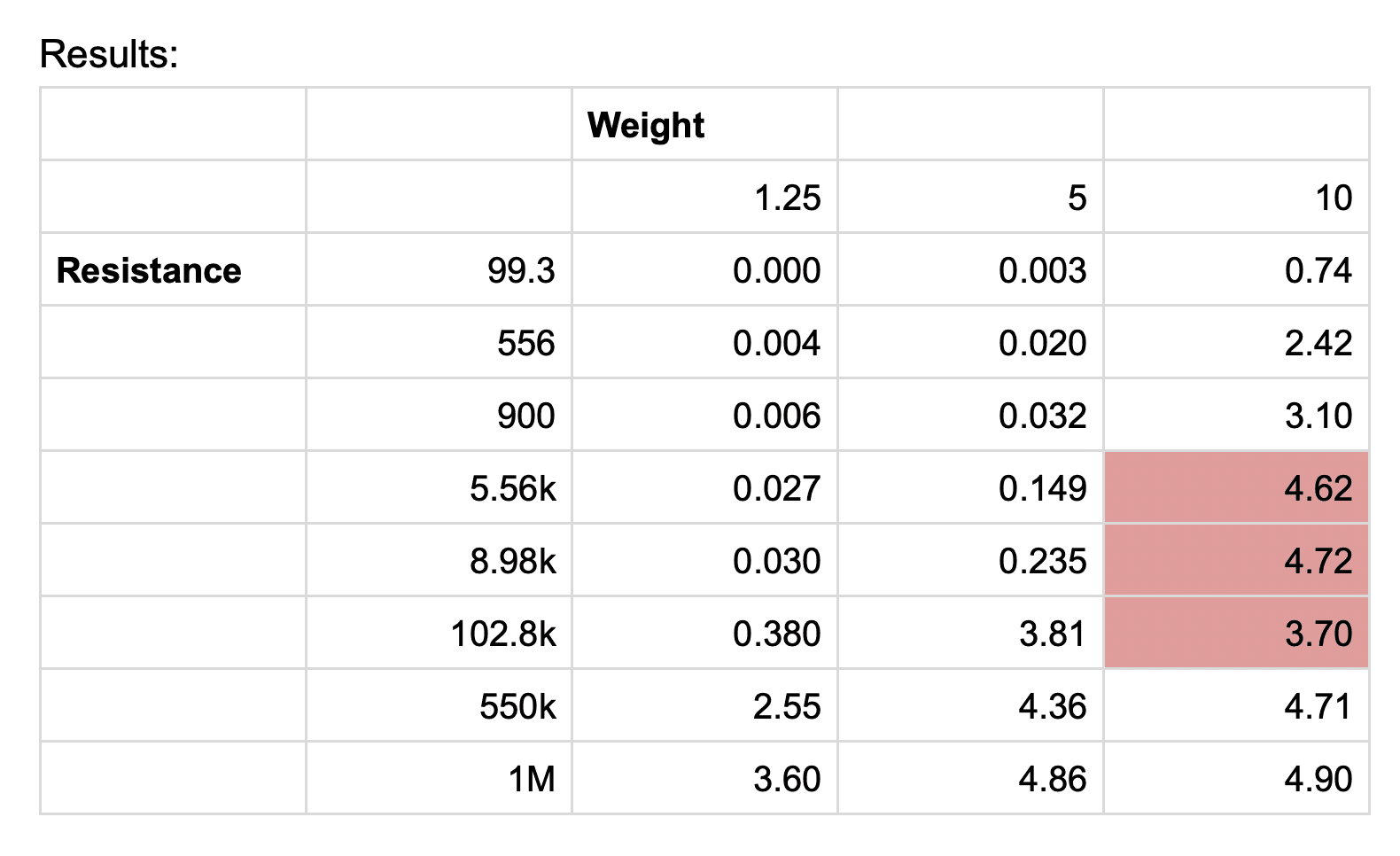
We built a simple velostat sensor and connected it to a circuit. The weight on the sensor and the resistance in the circuit were varied, and the voltage across the sensor was measured. The sensitivity of the sensor is defined as the rate of change of voltage with respect to the weight.


Data Analysis & Results
After collecting raw data, we processed and visualized the data with a 3D chart in MatLab to see the behavior of the velostat sensor, and to figure out an appropriate resistance value providing an ideal working range, in which the voltage varies linearly with weight. As a result, we found that a lower resistor value implied higher sensitivity to changes in pressure, and we identified that 2k ohm resistor was most ideal for providing a usable working range for our prototype.


" height="173.3573819462307px" id="uYSDJXpWY" transform="translate(13 13.5)" width="174px"/></svg>)